
Taking your horn in for a thorough cleaning is something that many people (me included) don’t do quite as much as we should.
However, keeping your horn – especially the leadpipe – clean is one of the most important things to make sure your horn plays as well as it possibly can. Especially with most brands of triple horns – the combination of a short(er) leadpipe and no easy access for a snake meant that the only real way to keep it clean was to get a chemical or ultrasonic cleaning.
However, there is a new (to me) option for cleaning all horns that makes it easier to keep your horn clean between trips to a horn shop for deeper cleanings.
First, though, a review of the two current horn cleaning options.
(Old) Option 1: Snake
I’ve always been taught (and believe) that the most important part of a horn to keep clean is the leadpipe.
There are a couple of reasons for this:
- The leadpipe taper is incredibly important in controlling how the horn sounds, plays, and feels. Any gunk that disrupts the tapers will have a large impact.
- If you can keep the leadpipe clean, you can reduce the need to clean the rest of the horn. Obviously, most gunk will come in through the leadpipe, so cleaning it out regularly will prevent things from moving further into the horn (and into the valves).
The most common and obvious way to clean the leadpipe is with an instrument snake. These can be found in almost any band instrument store, or online (here’s one on Amazon). Make sure you get one made for French horn (or trumpet) – the trombone/tuba ones are too large to fit into a horn leadpipe.
Using a snake is relatively straightforward, but I have instructions on my French horn Cleaning and Maintenance page, if you need a reminder.
While a snake works great for cleaning almost every double horn, it won’t work for most triple horns (mine included), since the leadpipe doesn’t have a slide (the leadpipe leads straight into a valve). Using a snake would push all the gunk directly into this valve (and possibly cause lots of other issues).
(Old) Option 2: Spitballs
Herco Spitballs are not quite as popular or effective as a snake, but I think they do a nice job as an additional cleaning device.
On my double horn, my usual procedure was to use a snake to loosen the leadpipe debris, and then run a few Spitballs through the leadpipe to remove whatever the snake left behind. And usually, the snake left behind a noticeable amount.
Using Spitballs is essentially the same as using a snake, except after inserting into the leadpipe, you’ll blow them through the leadpipe and out of the main tuning slide (have a cloth or towel covering the opening so you don’t spray gunk everywhere).
A couple of notes:
- Make sure to remove the main tuning slide (usually immediately after the leadpipe). If you don’t do this, the Spitball will be blown into the body of your horn, and it’s much harder to remove.
- While you can reuse the Spitballs during a cleaning session (simply rinse them with water), I would not put used Spitballs back in their container – even if you clean them. I’ve had mold form from trying to reuse Spitballs too much, so after I run one through a horn a few times, I throw it away.
The downside, though, is that these still pose most of the same drawbacks to cleaning a triple horn as a snake.
Note
I have used Spitballs to clean my Schmid triple horn in an emergency. I don’t recommend it, however, since there are some tight bends and the potential for a Spitball to get stuck.
Since there is no tuning slide for the Spitball to come out of, I removed the first Eb valve slide and used the Spitball with the Eb trigger and first valve depressed. This made for some tight turns (I had to blow quite strongly to get the Spitball out), but this is the shortest path to get the Spitball out of the horn.
If you try this, you do so at your own risk!
NEW Option 3: Hydro-Jet
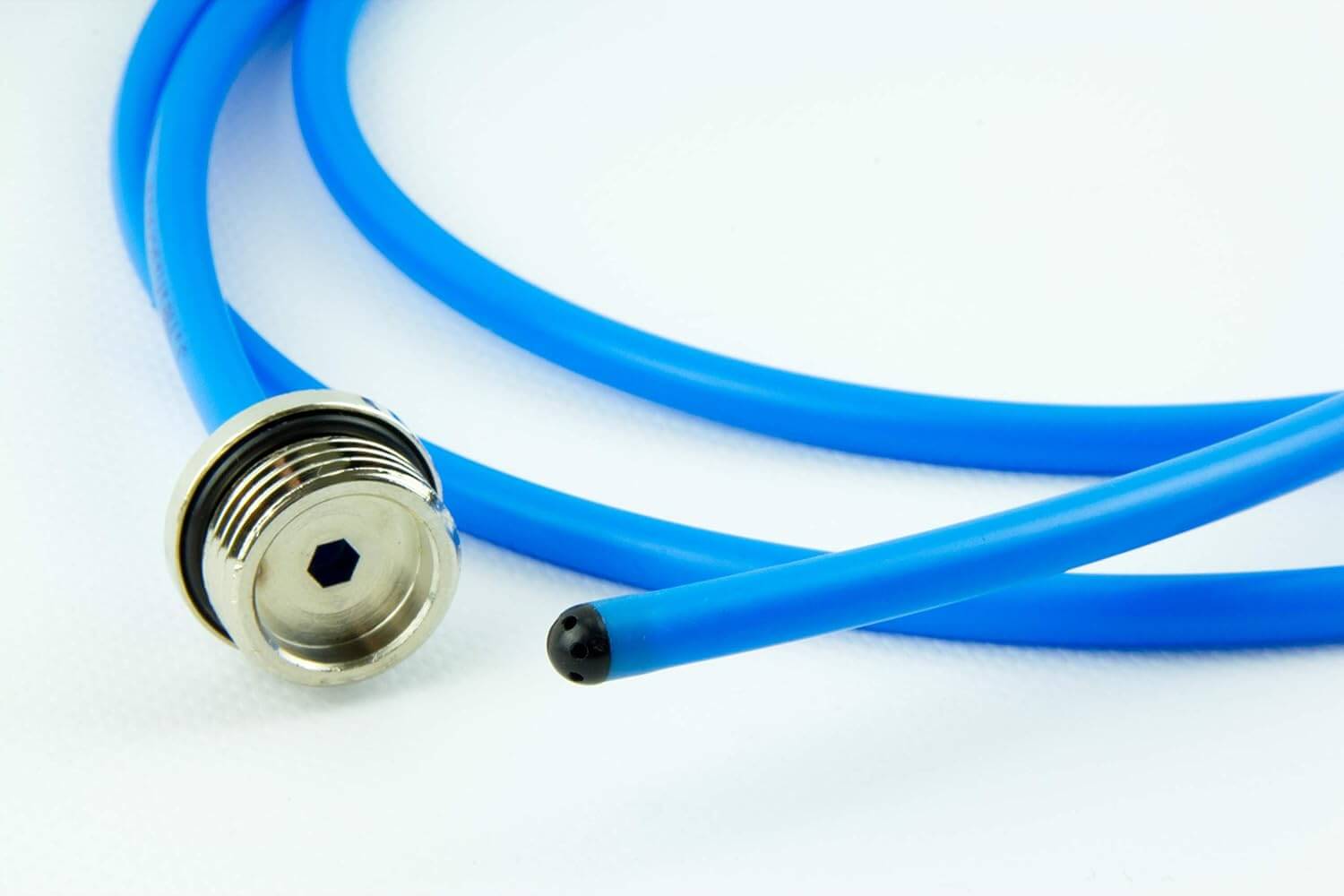
This was something I just happened to see this past November and looked interesting: the Meinlschmidt Hydro-Jet Cleaning Hose.
You can find it at Houghton Horns or Amazon.
It is essentially an attachment for your shower (if you have a shower with a handheld wand) that functions like a traditional snake (but a bit longer) and with four water jets that shoot out water at a surprisingly high pressure.
I’ll expand on the device a bit more, but the overall verdict is that this worked great.
The only con for this device in its current form is that without any sort of on/off control on the Hydro-Jet, the only way to stop the water flow is at the shower faucet. Depending on your shower and how you’re cleaning your horn, turning the water on and off quickly may be challenging, which means messes will be made.
The first time I used this was comical. While I was smart enough to put it in the leadpipe before turning it on, when I saw how effective it was, I wanted to try and get the rest of the horn done quickly – bad idea. When I removed the snake, water went everywhere, and trying to get it into other slide legs caused a lot of blowback spray.
Aside from that learning curve, this device worked like a charm.
- It removed quite a bit of gunk from my triple horn – not only the leadpipe, but from other tubing sections as well.
- I used it on my double horn also (after snaking/Spitballing), and it was able to get more stuff out. The hose nozzles are fairly small, and so the water pressure is quite high, so it seems to remove gunk that is more “stuck on”.
- Although this does have the potential to blow gunk into the valves, because of the high water pressure, in my experience, it also will eventually blow the stuff out of the horn. I ended up trying to give it 45-60 seconds for each section of tube to make sure it didn’t leave much behind.
- Even without plumber’s tape on the threads of the Hydro-Jet, there was no leaking from the shower fixture or the hose portion of the snake.
- After cleaning, you will almost certainly need to re-oil and re-grease your entire instrument.
Final Thoughts
While effective for cleaning the inside of the French horn (and other brass instruments, I imagine), this device is not a substitute for taking your horn to a competent repair person for regular cleanings (either ultrasonic or chemical).
Not only will a good repair person likely get your horn cleaner, inside and out, they will be able to see any sort of warning signs for upcoming issues, remove minor dents, find loose braces, or other small things that may escape the notice of an average player. Plus, developing a good relationship with a repair person will help if you ever have a horn emergency.
But, if you’re wanting to keep your horn (especially triple horn) clean between visits, I recommend the Hydro-Jet Cleaning Hose as an excellent option for any style of horn (but especially triple/descant horns).

Leave a Reply
You must be logged in to post a comment.